 Conclusions
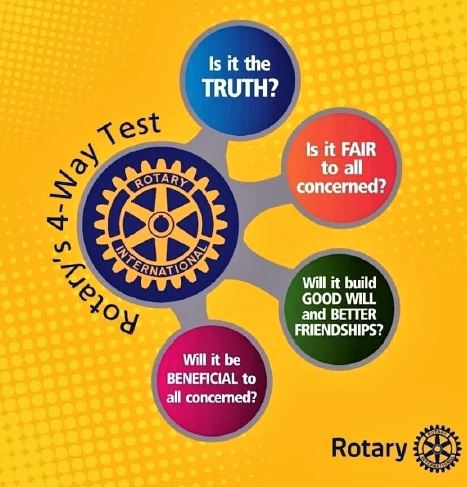
At the start of this series, I posed the question whether the Four-way Test remains a relevant and practical guide to ethical decision-making in the modern world. I think the foregoing analysis leads to the conclusion that it does
The values underpinning the test are timeless, and if the test is used as a guide, and not a rule, then it remains as relevant and useful a general guide to action as it proved to be in restoring the fortunes of the Club Aluminium Company.
Most decisions we make in a work or personal context are straightforward, and ethically right or wrong actions will be intuitively clear. In these cases, there will be no need to consciously apply the Test, or engage in an ethical analysis.
But sometimes the answer to the question ‘How should I act?’ is not clear-cut, and the most ethical course of action will not be obvious at first sight. We may even face an ethical dilemma, that is, a decision requiring a choice between moral imperatives where neither is unambiguously acceptable or preferable, and obeying one moral imperative will result in breaching the other. An example is when you cannot keep a promise of confidentiality to one person without lying to another.
It’s in these situations that the Test is most useful, and using ethical theory to evaluate options gives you confidence that the decisions you make will be carefully considered and ethically sound.
It may appear that the ethical theory most closely aligned with the Four-way Test is utilitarianism, and it’s true that parts of the Test call to mind a typical utilitarian decision-making process such as the following.
- Identify the decision to be made.
- Consider optional actions.
- Identify all people affected.
- Determine the net utility[1] of each option.
- Choose the option with the highest net utility.
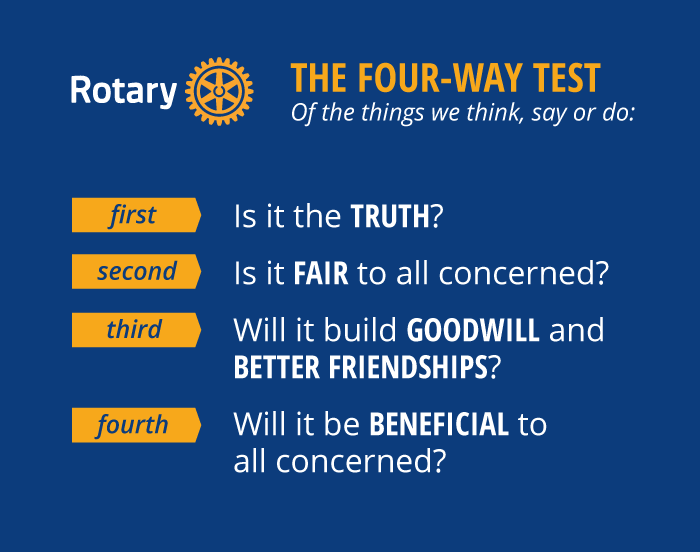 However, this process makes no reference to the values of truthfulness, fairness, goodwill, or friendship, which are integral to the Four-way Test. These values will not necessarily feature strongly in a utilitarian analysis, and accord more closely with Kantian, virtue ethics, or ethics of care approaches.
 To take account of the four values in the Test, Step 5 of the utilitarian model needs to be modified to include reference to these values and the ethical theories underpinning them.
A sixth step may be necessary in situations where it is not possible to fully satisfy each part of the Four-way Test.
The modified reasoning process might look like this.
- Identify the ethical decision to be made.
- Consider optional actions.
- Identify all people affected.
- Determine the net utility of each option.
- Choose the option with the highest net utility and check whether that option:
- is based on the truth
- is fair to all concerned
- will build goodwill and better friendships
- respects the rights and autonomy of all concerned, and
- demonstrates other relevant virtues such as wisdom, compassion, loyalty, sustainability, and accountability.
- If any of the values in 5(a) to (e) are not satisfied, consider whether that option could be modified to satisfy that value to the greatest practical extent.[2]
At this point, you may be thinking: ‘Why is it necessary to formulate what appears to be simply an expanded version of the Four-way Test?’
The reason is that there is a difference between a decision-making process and a formula for testing whether decisions made are ethical. The Four-way Test, as its name suggests, is the latter.
The decision-making process above does not replace the Four-way Test. Its purpose is to provide a way of developing options that satisfy the Test. The reference to ethical theories in Step 5 provides reasoning tools that help us apply the Test in more complex and ethically ambiguous situations. Considering options for action in the light of each ethical theory helps ensure that our eventual decision is thoroughly evaluated and that no ethical weaknesses are left unexamined.
[1] ‘Net utility’ means total utility (benefits such as well-being and happiness) resulting from an action, less total detriments (such as hurt and unhappiness) resulting from the same action.
[2] Note that not all requirements in step 5 need be satisfied. Surrounding circumstances may make it impractical, or even impossible, to meet them all. For example, there may be no solution that is fair to all concerned. But if it is possible and practical to modify an option to match those requirements more closely then this will ensure that an ethically optimal decision is made.