 January was Rotary's Vocational Service Month: Vincent Chen and the Vocational Service Committee initiated a new programme in which members describe how their occupation has changed.
However our concept of "Vocational Service" is sometimes hard for new Rotarians to grasp, so we present a series of notes on the subject.
The Object of Rotary is a philosophical statement of Rotary’s purpose and the responsibilities of Rotarians. The concept of vocational service is rooted in the second object, which calls on Rotarians to encourage and foster:
• High ethical standards in business and professions
• The recognition of the worthiness of all useful occupations
• The dignifying of each Rotarian’s occupation as an opportunity to serve society
As a Rotarian, how can you put these ideals into action? Consider these suggestions:
• Talk about your profession in your club, and take time to learn about fellow members’ occupations.
• Use your skills and expertise to serve a community.
• Practice your profession with integrity, and inspire others to behave ethically through your words and actions.
• Help young people achieve their career goals.
• Guide and encourage others in their professional development.
By undertaking these activities, you bring vocational service to life. Vocational service is the essence of Rotary and serves as the foundation from which we serve our communities around the world.
INTEGRITY AND ETHICS
Rotary emphasises integrity and high ethical standards. Two standards developed by Rotarians — The Four-Way Test and the Rotarian Code of Conduct — provide a road map for ethical behaviour in the workplace and other areas of life.
THE HISTORY OF THE FOUR-WAY TEST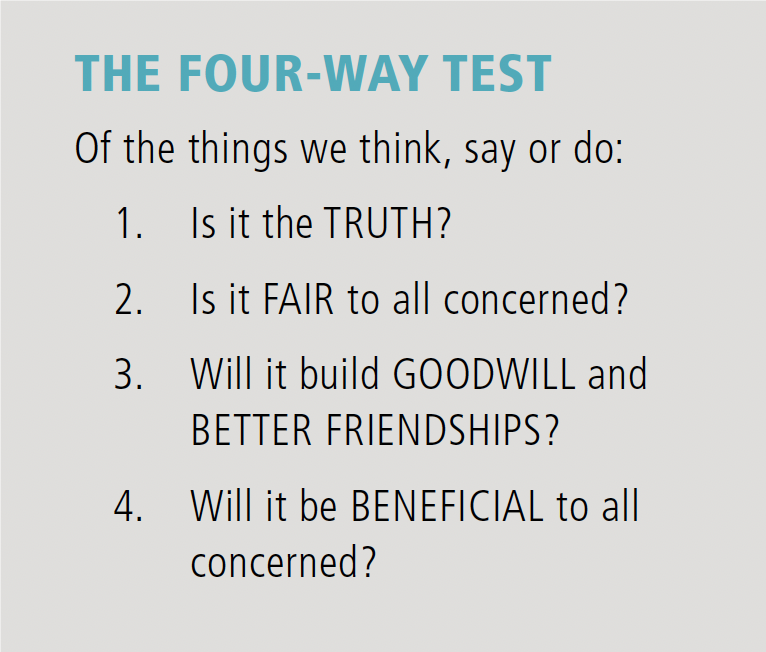
The Four-Way Test was conceived in 1932 by businessman Herbert J. Taylor, a member of the Rotary Club of Chicago, Illinois, USA, who
served as Rotary International president in 1954-55. Having taken on the task of saving a company from bankruptcy, Taylor developed the test as an ethical guide to follow in all business matters. The company’s survival was credited to this simple philosophy. Adopted by Rotary International in 1934, The Four-Way Test remains an essential standard against which Rotarians measure ethical behaviour.
It has been translated into dozens of languages and promoted by Rotarians worldwide.
ROTARIAN CODE OF CONDUCT
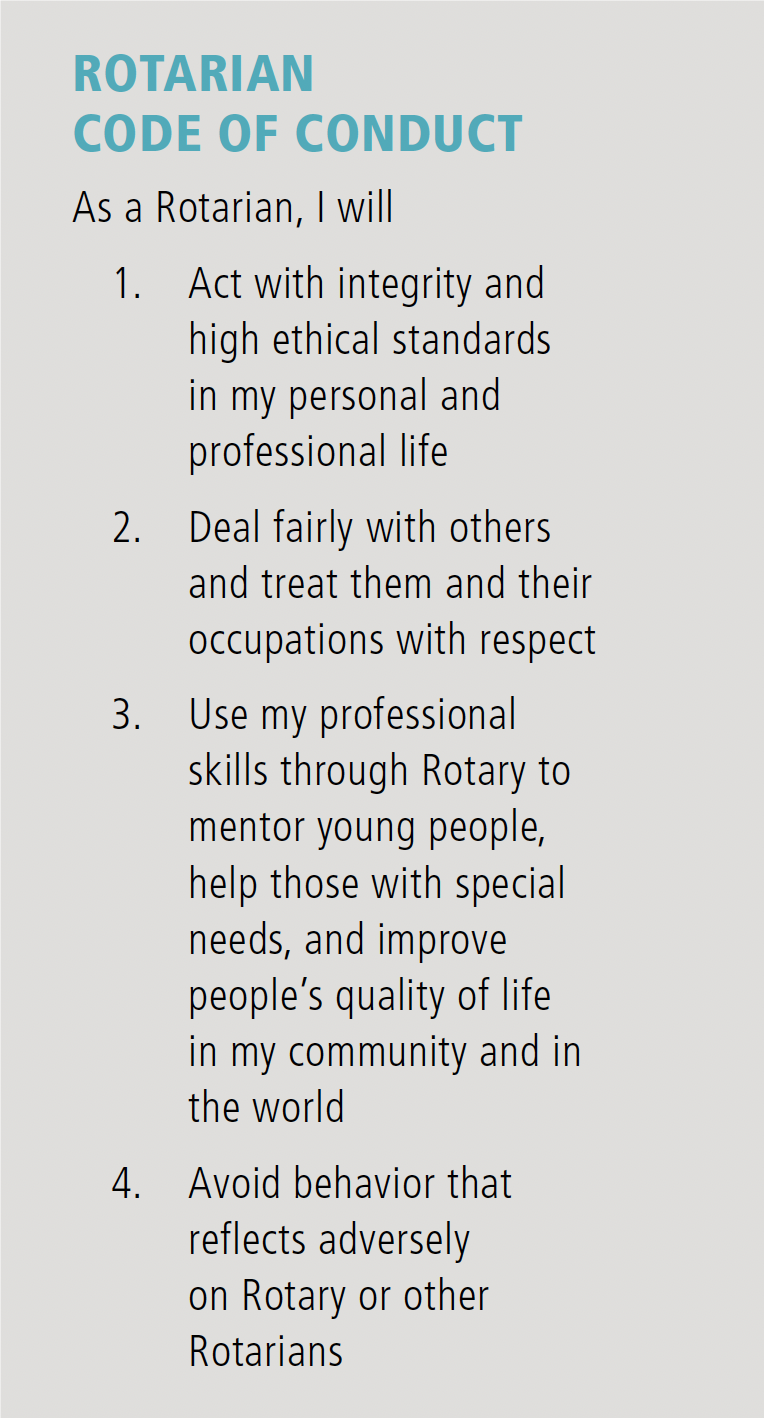 The Rotarian Code of Conduct provides a framework for ethical behaviour that all Rotarians can use, together with The Four-Way Test, in their business and professional activities.
As part of Rotary’s guiding principles and the Avenues of Service, Vocational Service calls on Rotarians to empower others by using their unique skills and expertise to address community needs and help others discover new professional opportunities and interests.
SKILLS OR OCCUPATIONS
By including men and women from diverse professions and backgrounds, Rotary recognises the importance of all skills and occupations. A vibrant Rotary club reflects the businesses, organisations, and professions in its community, embracing diversity in experiences and perspectives. Your professional life and vocational service go together. Rotarians have a dual responsibility: to represent their occupations within their club and to exemplify the ideals of Rotary in their places of work.
ADVANCING HIGH ETHICAL STANDARDS IN THE WORKPLACE
As leaders in their businesses and professions, Rotarians can advance high ethical standards by setting a positive example among colleagues and in their community. Here are a few specific ways Rotarians integrate ethics into their daily work life:
• Discuss and emphasise honesty, accountability, fairness, integrity, and respect when hiring, training, and supervising employees
• Praise and encourage the exemplary behaviour of colleagues
• Demonstrate personal commitment to high ethical standards in relations with customers, vendors, and business associates, treating each business interaction with care and consideration
• Promote socially and environmentally responsible practices in your businesses and organisations