The Hawthorn Rotary Bookworms were scheduled to discuss Jane Garman’s “Old Filth” this week, but circumstances led to us postponing the meeting till the 4th of December. This means there is still time for you to pick up a copy or download it from Kindle and join us for an hour on Zoom. Just let me (Ian Bentley) know, and I’ll send you a link. The book is an easy and entertaining read. An example of the diversity of the books explored by the Bookworms over the last couple of years.
| ||
 |
| |
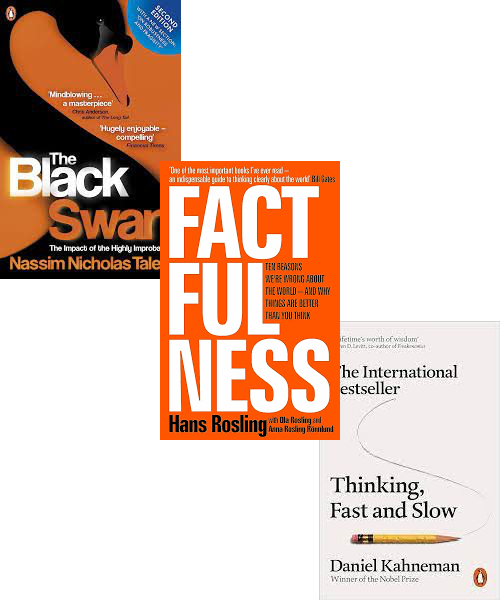
These and other popular books of the last decade emphasise the importance of recognising and overcoming cognitive biases, questioning assumptions, and approaching information with a more discerning mindset. Each book has its unique focus and approach, but they converge on the ideas of challenging misconceptions, promoting critical thinking, and providing a more nuanced understanding of the world.
Here are some recurring themes. That these common ideas have evolved independently gives weight to their veracity and makes them worthy of serious consideration.
Cognitive Biases
Books such as Kahneman's "Thinking, Fast and Slow" delve into the various cognitive biases that influence decision-making. Similarly, "Factfulness" touches upon biases, including the instinct to focus on dramatic events and the tendency to form opinions based on preconceived notions. Both emphasize the need to be aware of these biases for more accurate perceptions. Both authors acknowledge the evolutionary origins of our faulty thinking. Many of our hardwired thinking tendencies may have aided human survival on the savannas of Africa 200,000 years ago, but they are often an impediment to effective thinking when more careful consideration is needed.
Data-Informed Decision Making
Hans Rosling's focus on a data-driven approach to understanding the world aligns with the emphasis on empirical evidence found in books like Steven Pinker's "Enlightenment Now" (2018). Both works emphasise the importance of basing conclusions on factual information rather than succumbing to gut feelings or anecdotal evidence.
Global Perspective
"Factfulness" addresses global misconceptions and challenges readers to reassess their views on worldwide issues. Similarly, Yuval Harari's "Sapiens" (2014) and "Homo Deus" (2015) offer global perspectives on human history and future challenges, encouraging readers to rethink their assumptions about the world.
Critical Thinking
Books like Daniel Levitin's "A Field Guide to Lies" (2016) and Daniel Kahneman's "Thinking, Fast and Slow" provide practical advice for improving critical thinking skills. "Factfulness" also contributes to this genre by offering specific Factfulness principles that guide readers in developing a more fact-based worldview. Critical thinking is more important than ever in a world awash with political spin, journalistic sensationalism, and deliberately deceptive advertising and scams.
Public Perception vs. Reality
Similar to books like Michael Shermer's "The Believing Brain" (2011) and Daniel Levitin's "A Field Guide to Lies," "Factfulness" explores the disjunction between public perception and objective reality. Rosling's work emphasises the importance of aligning one's worldview with factual information rather than succumbing to prevalent misconceptions. I can’t help but cringe when a journalist says, “It fails the pub test”. While public perception might influence the opinions of pub-goers, it is hardly a measure of sound reasoning and informed decision-making.
As Rotarians, we need well-informed and reasoned perspectives on the world to strategically target our efforts.