 For the next Vocational Enterprise Forum, Vincent Chen has sent us a sneak peek at Commodore Peter Scott's book, “Running Deep: an Australian Submarine Life”.
Just a sample from the Prologue:
‘Flood, flood, flood! Flood in the lower motor room.’
We are dived hundreds of metres beneath the sea surface and there are thousands of metres beneath us. It is light up there, but dark down here, and blacker still in the dense abyss. 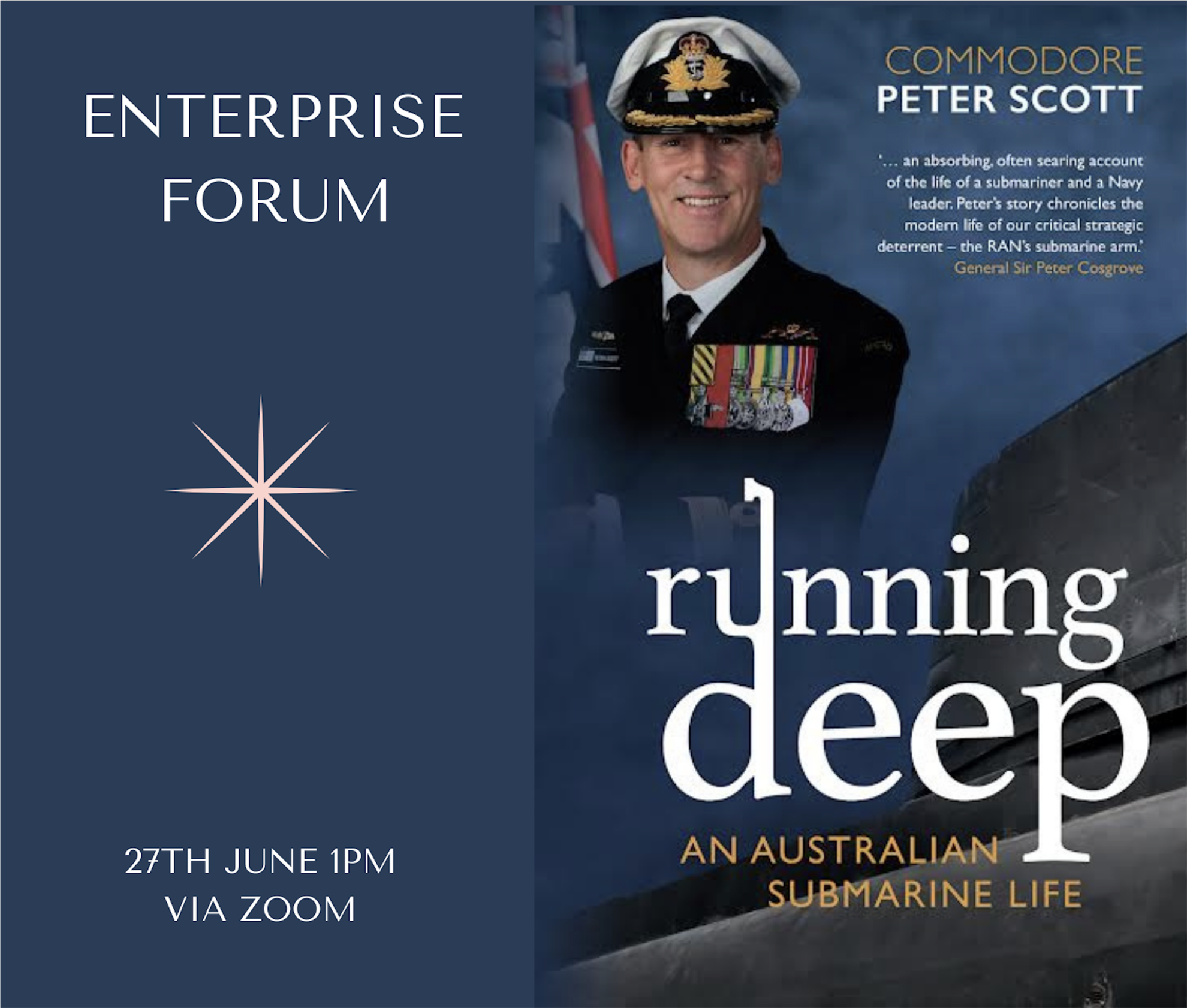
Standing beneath a main hatch near the bows of the submarine, I meet Mango’s eyes, just inches from mine. I meet Johnny’s eyes; he is as close. They vanish, racing to their emergency stations, and so do I.
Within seconds, I am in the control room. My Executive Officer has the weight as Duty Commanding Officer, so today it’s his boat. We are at Deep Diving Depth, the submarine is under immense pressure and flooding uncontrollably.
‘Emergency Stations, Emergency Stations. Flood, flood, flood. Flood in the lower motor room.’
Strident but steady, the Ship Control Officer of the Watch picks up the alert from the sailors back aft, sounds the alarm and sends the report over the main broadcast again. No mistaking it this time, there was no mistaking it last time.
‘Full ahead. 20 up. Midships. Blow main ballast. Blow emergency main ballast. Shut all hull valves.’
The emergency orders ring out and are immediately acknowledged by the operators. The panel watchkeeper cracks the valves to hear the rattle, blast and hiss of high-pressure air pushing into the ballast tanks. Our laconic Chief of the Boat is on the planes. He lifts and artfully holds the nose of the submarine. The revolutions come on and we start to surge forward. They know the drill and are already onto it. But this is no drill.
In an instant, we have gone from knowing the state of our submarine in intimate detail to endless unknowns. What failed and caused the flood? How fast are we flooding and how much weight have we already taken on? What is the state of our systems? What damage has been suffered and what is the ongoing risk? Where is the water? Are my people drowning? Are they dead? Has it been stopped? Can it be stopped? Am I going to die?
Breathe.
My heart is beating through my neck. I imagine the unbearable shock, noise and damage happening aft, beyond the watertight bulkhead doors. I know – we all know – that if we go down in this depth of water, we will be crushed by the pressure before we hit the bottom. Once the pressure hull splits, the ocean’s onslaught will be absolute in its violence. There’s much more out there than we have room for in here. There is no coming back.
We’ve been here before. We’ve trained for this. Some of us have trained for this our whole adult lives.
‘I have the submarine,’ I say, resuming full command.
It’s much quieter now. HQ1 reports they are closed up; sonar is calling sweeps for clearance; ‘20 up,’ from the Chief on the planes.
But the reaction is over. All of the Emergency Operating Procedures are done and we’re now pumping on anything that can draw a suction. Standing between the periscopes in the centre of the packed control room, I feel the eyes of one of my sailors fixed on me. I meet his gaze. He is searching for the answer to a singular question: ‘Can we survive?’ He sees that I don’t know, but I am still in the fight. My eyes return to the depth gauge.
We’re sinking. We’re beneath Deep Diving Depth, and we’re sinking.
That should give you an idea what to expect, when Commodore Peter Scott speaks to us Via ZOOM on June 27th.