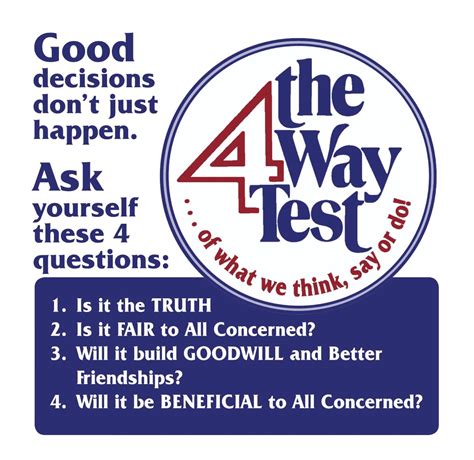
 Part 3: Applying the Four-way Test
Before we start to start to consider how the moral theories outlined last week can help us apply the Four-way Test, it’s important to remember that it is a ‘test’, and not a ‘rule’.
The Test doesn’t impose mandatory requirements for decision-making. Taylor wrote that the Test was not designed to:
‘tell our people what they must do, but ask them questions which would make it possible for them to find out whether their proposed plans, policies, statements or actions were right or wrong’.[1]
So, a decision will not fail the Test simply because one of the four parts of the Test cannot be answered with an unqualified ‘Yes’. It is intended as a guide to decision-making, and a decision will pass the Test if it gives effect to the values in each part of the Test to the greatest practical extent in the circumstances.
1. Is it the truth?
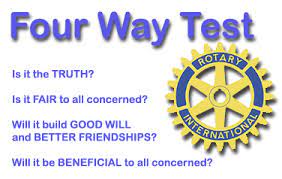 The first part of the Test asks whether something is true. If it’s not true, then it should not be acted on. That is clear enough. But if something is true, does the Test intend that we always act on it, wholly and without exception?
Might this depend on consideration of other parts of the Test? If we tell the truth, will it be unfair to anyone; damage goodwill or friendships, or not benefit all concerned?
One can imagine circumstances when telling the whole truth might not satisfy other parts of the Test.
A classic moral conundrum of this kind arises in medical practice. Take the situation where a patient has been diagnosed with a terminal illness and has only weeks to live.[2]
If you adopted a utilitarian approach you would consider whether complete candour regarding the prognosis would result in net benefits to all concerned, or whether on balance telling the whole truth would cause more harm than good.
A Kantian approach would focus on respect for patient autonomy, the patient’s right to know the truth, and the medical practitioner’s duty not to lie. On the other hand, there is also a patient’s right not to know the truth to consider. In some cases, patients may not want to be given full information about their health condition.[3]
Ethics of care would focus on the care of the vulnerable patient and their loved ones. Considerations would include the effect the truth would have on the patient’s mental state, and their ability to make informed decisions about future medical care and end-of-life arrangements.
A virtue ethics approach might involve seeking the Golden Mean between the excess of unbridled candour (heedless of the psychological impact or patient and family wishes), and the deficiency of lying and telling the patient their prognosis is excellent. Alternatively, you might consider what a virtuous medical practitioner would do. The traditional medical virtues are beneficence, non-maleficence, justice and autonomy, to which you could add social intelligence and good judgment.
A further issue regarding the truth part of the Test is how far you are morally obliged to go to satisfy yourself about the truth of something before you act on it.
A utilitarian approach would consider whether the benefits of an inquiry into the truth would outweigh the cost and any potential harms involved.
From a Kantian perspective you could not make a universal rule that people act on information regardless of its truth, because this would condone acting on information that was potentially untrue, which would involve deceiving those affected; and lying is wrong because it cannot be a universal rule.
Adopting a virtue ethics approach might entail finding the Golden Mean between the extremes of acting on information regardless of its truth, and going to exhaustive lengths to establish whether it was true.
Ethics of care would focus on preserving the relationships of people potentially affected by the information, and this would mean taking reasonable care to ascertain the truth of something before acting on it.
You might consider that a serious doubt about the truth of something was sufficient moral reason not to investigate it further; and if you did decide to investigate, the extent of your inquiries might well depend on the significance of action that might follow from establishing the truth or untruth of the information.
The foregoing analysis suggests that while reasonable steps should always be taken to establish the truth of something before acting on it, the truth of something may not, of itself, be sufficient reason to act on it. Whether, or how, you should act might depend on other factors, including how you answer other parts of the Test.
We’ll look at the other parts of the Test next week.
[1] https://www.rotary5630.org/history-of-the-four-way-Test/
[2] Dr Yusrita Zolkefli, ‘The Ethics of Truth-Telling in Health-Care Settings’, Malaysian Journal of Medical Sciences, May 2018.
[3] There are four situations in which non-disclosure to a patient may be justified: 1) where the patient makes an informed decision that they not be told the full truth. 2) where a patient is too compromised mentally to be able to receive and process the information, 3) where a patient’s mental condition is so unstable that ordinary disclosure would be unsafe, and 4) where there is compelling evidence that disclosure will cause real and predictable harm and a ‘therapeutic privilege’ justification might be claimed – P. C. Hébert, ‘Truth-telling in clinical practice’, Canadian Family Physician vol. 40, December 1994: https://www.ncbi.nlm.nih.gov/pmc/articles/PMC2380404/