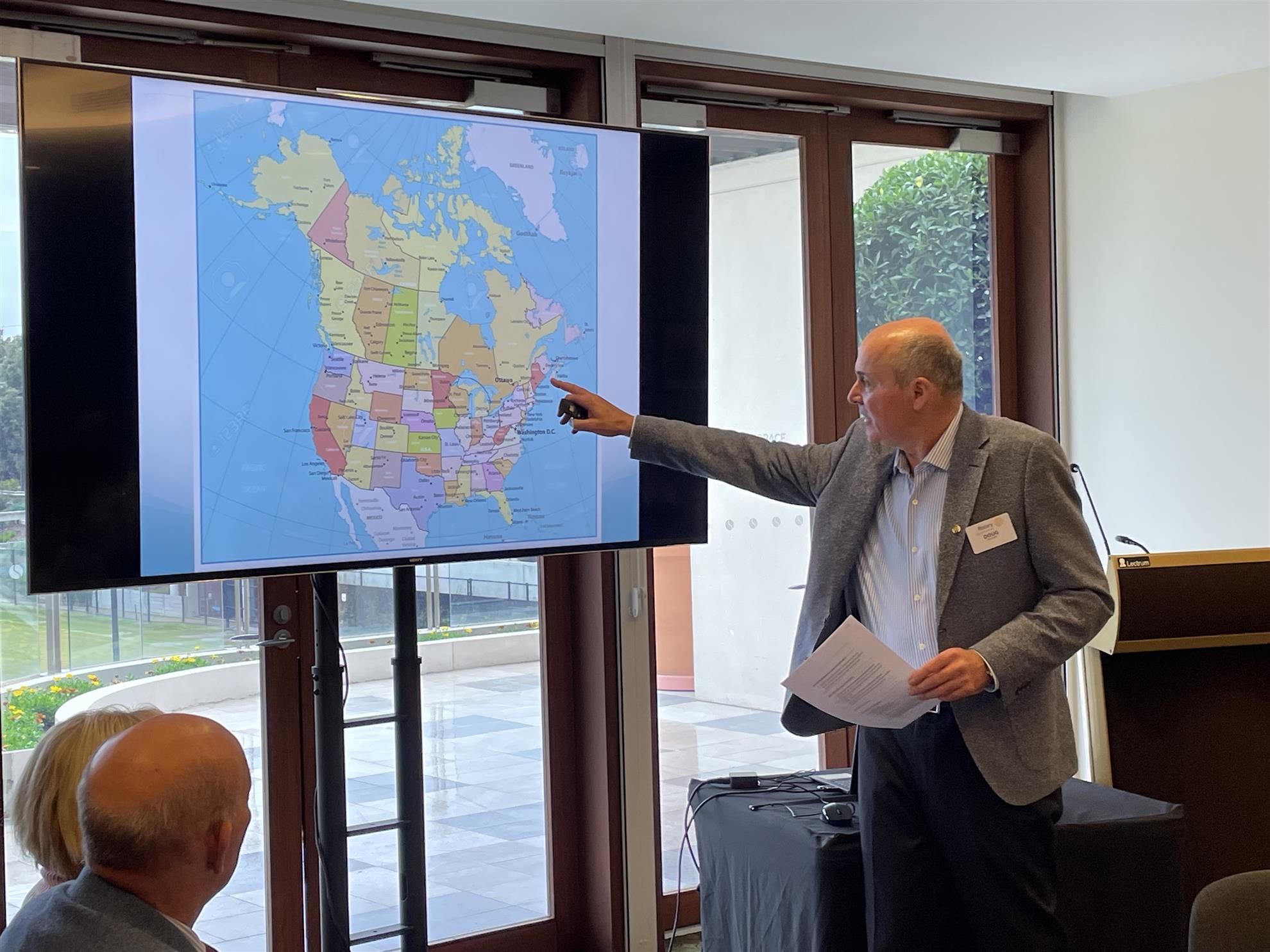
President Doug gave us a description of growing up in a border town, skilfully mixed in between a history and a geography lesson.
Today is the 4th of July US Independence Day which as most of you will be aware is a major celebration across the USA. Canada’s national day is 1st July which in typical Canadian fashion is a much lower key celebration.
Canada and the USA have a lot of shared history mostly peaceful as neighbours especially over the past 207 years, they had a small dispute in 1812-14 which led to few minor battles along the border region.
Today most of the disputes are trade related with things like dairy products, lumber and Canadian back bacon being matters discussed by the President and PM at their annual catch-ups. Who doesn’t like Canadian back bacon?
From my experience students in Canada are given a much more in-depth knowledge of US and Canadian history than our counterparts in the US and to be honest the US version either excludes some events or paints them in a very different light.
Canada and USA Map
· Canada is 2nd largest country in the world
· USA is 3rd largest
· Australia is 6th largest
· Border between Canada and USA is 9,000 kms
· Drive from St John’s Nfld to Victoria BC 5,000 kms
· Drive from Melb to Perth 3,400
· Longest undefended border in the world
· USA 13 Colonies went from Maine to Georgia
· Essex county and Harrow same latitude as Northen California
Essex County map
Doug described how his home town of Harrow is farther south than we would expect.
· Most southern point in Canada
· Surrounded by water Great Lakes and Detroit River
· Names are all of English counties and towns
American Revolution
Doug described some significant dates, and how British subjects and others were expelled after the US Civil War.
End of American Revolution 3rd Sept 1783
Abolition of Slavery in Upper Canada (Ontario) 1793
American Prohibition of Alcohol 1920-1933
US Civil Rights movement 1959-1964
The Treaty of Paris in 1783 signed by Britain and US ending the war, and as a result of the treaty 70-80,000 British subjects living in the 13 American Colonies were forced to relocate. The population of US 13 Colonies was 2 million at the time, and 4% were expelled. Some of the people had to relocate 1,500 kms to get to Canada other went over the border from Maine to Nova Scotia. Very few had the connections or money to travel back to the United Kingdom, and the majority were relocated to Canada
Who were these Loyal British subjects?
British Subjects Relocated to Canada
Hessian soldiers were hired by the Crown to fight the American Colonists due to a shortage of English solders fighting wars with France and Spain, Hessian soldiers were not mercenaries the German municipalities collected all the monies from the Crown for their services overseas. My mother’s family trace their ancestry to the Hessian soldiers. A lot of highly educated people were forced to leave the US as part of this relocation
Where did they go in Canada?
 At this time Canada had some settlements in Eastern Canada (Nova Scotia and New Brunswick) and French Canada (Montreal and Quebec City) The French Canadians made it very clear they did not want these English people coming into their region and impacting on their culture.
Atlantic Canada (Nova Scotia and New Brunswick) could only handle a small number of the settlers. so Upper Canada (Ontario) was considered the best option as it had vast areas of frontier land available for settlement
United Empire Loyalists
The new British subjects were referred to as United Empire Loyalists (UEL’S) in Canada. This included anyone with a direct connection to the King, British and German Hessian soldiers, Senior members of the civil service, Judges, crown prosecutors and senior members of the police force.
Also teachers and university professors, Ministers and Bishops of the Anglican church, Business owners and other members of the public that supported the Crown during the war.
Whole families parents, grandparents, brothers and sisters were often included. Each family was allocated 200 acres of land (80 hectares), a horse or cow, some pigs, chickens, seeds for crops, basic hand tools, some building materials and enough staple foods for 6-12 months.
The majority of the UEL’s had no background in clearing land, building homes and farming: as a result they suffered significant hardships in the initial period but persevered and became the backbone of their communities.
Abolition of Slavery
Ontario was one of the first regions within the UK colonies to abolish slavery (Britain abolished it in 1807)
From 1793 onwards an informal group known as the Underground Railway assisted African Americans in slavery to escape to Canada. They basically operated a series of “safe houses” from the Southern US states to Detroit and across the river to Windsor, Canada.
Underground Railway
Estimated up to 20,000 people used the Underground Railway between 1793 and 1861, the start of the US Civil War. When escapees arrived in Canada they were considered free citizens but had no formal government support: the majority had to rely on local church groups and prior escapees for support. At the end of US Civil war about half relocated back to US and balance stayed in Southern Ontario.
American Prohibition of Alcohol
The bootleggers were happy to sell alcohol to the rich and the poor and keep all the money for themselves. Prior to the Prohibition of Alcohol in the US in 1920 four entrepreneurial Americans came to the Windsor border region and set up large Canadian whiskey distilleries. Canadian Club whisky is still made in Windsor today.
Al Capone and his band of “Merry Men” had the whisky placed on lake freighters and in the middle of the lake it was transferred to speed boats to smuggle into Chicago and other near by US cities.
US Civil Rights Movement 1954-1964
Initially a peaceful movement but it became more radical in the late 1960-70 leading to racial riots in major US cities including Detroit 1967-68 following Martin Luther Kings assassination in 1968. In many ways Detroit never recovered from the riots and has been in decline ever since.
The movement started in 1954 with the abolition of racial segregation laws across USA. Many US states in the Southern region continued with variations of the segregation laws. The Civil Rights movement was mainly a peaceful movement to allow full integration of African Americans.
Education, transportation and accommodation were the main areas of focus and Martin Luther King was a well known leader of the movement.
My first day of school - Tuesday 6th Sept 1960
My father and his six siblings attended the same school 30 years earlier and after he and his three brothers completed grade 8 they went home to work with their father on their collective farms. My father’s 3 sisters all went on to further studies and became a nurse, teacher and local assistant bank manager.
The school was about 1 km from our farm and my family and cousins made up over one third of the class. It was a one classroom country school.
It had one teacher (Miss White) for years 1-8 and Student numbers were between 25-30, all the students were living on the nearby farms.
The school had limited resources and once a week a visiting music teacher for 2 hours, and education was focused on reading, writing and some basic math skills.
1964 Civil Rights Movement comes to Harrow
Harrow had a local school SS No 11 that was only attended by African American students. Similar to all the other local schools the students lived within walking distance to the school. Some local African American students did attend a larger school in the town.
In 1964 a Toronto newspaper the Globe and Mail did a series of stories about SS No 11 claiming the province had a segregation problem.
The school’s resources were considered inferior to the other schools in the area which was probably true due to the lower incomes among the local families to provide support to the school.
In 1964 the Minister for Education William Davis decided this was not a good look for the province and organized a consolidation of all the local schools in Harrow into a new school district under a new board.
The local School Board travelled to Toronto twice during this period and met with the Minister as well as department officials which indicates how serious the matter was being taken.
My father Allen McLean was elected to the new local school board and became Vice Chairman. The first order of business was to close SS No 11 relocate the students within the other local schools and commence building a new primary school in the town of Harrow.
New Harrow Elementary School facilities
The original plan had a swimming pool included but when the School Board met with the Education Dept staff in Toronto this was removed since it would have been the only school in the province to have a pool. I went on to graduate from the local high school, attended university in Hamilton Ont graduating with an Hon B Comm degree then completed my Chartered Accounting studies at PWC.
The new school had a gymnasium, science labs, music and art rooms and a kindergarten. A new principal was appointed and specialist teachers were recruited across all the areas of study. Academic outcomes for the students improved dramatically with a significant number of the students completing high school and moving to further studies at university and TAFE colleges.
Themes for Today’s Rotary
Provide support for persons displaced due to war and social unrest
Support educational opportunities for students within our local community
Never underestimate the power of the media to influence government officials to make positive changes
Banning alcohol sales does not always lead to a good outcome for society
Doug gave us his Travel Recommendations:
· City of Vancouver
· Rocky Mountaineer train trip
· Jasper and Banff plus Lake Louise
· Fly from Calgary to Toronto
· Polar Bear adventure in Churchill
· Toronto
· Niagara Falls but stay outside city at nearby Niagara on the Lake
· Ottawa if you like a bit of government pomp and history
· Montreal and Quebec City for French Canadian culture
· PEI for Anne of Green Gables fans
· Gander Newfoundland home of Come From Away musical
· Essex County and Harrow probably not high on the list for places to visit
Peter Lugg had introduced President Doug as "a nice guy", the only one of five children to move overseas. Peter bravely supervised the question and answer session, which elicited why Doug came to Australia: he had a contract with PWC to spend some years in New Zealand, and after ten years he moved to Australia, where he fortunately met Terry. He travelled to and from school in a traditional yellow school bus.
After Doug’s exposition, we all felt we knew a lot more about North American geography and history.